


Humidifier Guides and Support
Find Honeywell humidifier setup, cleaning, filter, water, indicator light, white dust, buying, and troubleshooting guides for common models and types.
Related Topics:

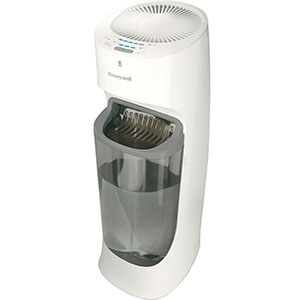
Honeywell evaporative humidifiers use model-specific wicking filters to absorb water and release invisible moisture into the room. Selecting the correct filter letter and part number is important because each humidifier housing is designed around a particular filter shape, size and airflow pattern.
If you are asking, “which Honeywell humidifier filter do I need?” begin by finding the humidifier model number on the rating label. Then use the Honeywell humidifier filter replacement chart below to match the model with Filter A, B, C, E or T.
Honeywell assigns letters to different wicking-filter designs. The letter identifies the filter’s physical format and intended humidifier family; it is not a performance rating. Filter A is not automatically better than Filter C, and Filter E is not an upgraded version of Filter C.
Each letter corresponds to a particular combination of dimensions, curvature, pleat arrangement and reservoir fit. The filter must sit at the correct depth in the water reservoir while allowing the humidifier’s fan to pull air evenly through the wet material.
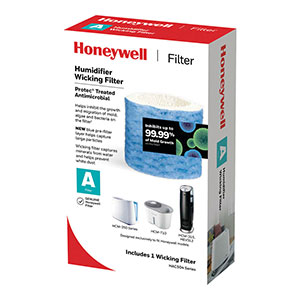
Additional characters in a product number may identify packaging quantity, color, revision or retail configuration. For example, HAC504PF1V2 is a current single-pack version of Filter A, while the underlying filter family remains HAC-504.
| Type | Filter Part Number | Compatible Honeywell Models | Filter Format and Notes |
|---|---|---|---|
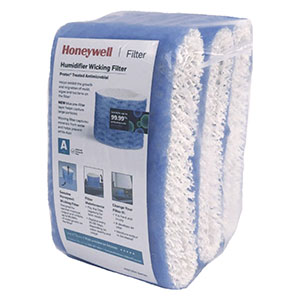
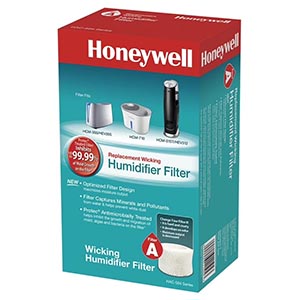
| Filter A | HAC-504 / HAC-504AW | HCM-300, HEV-300, HCM-500, HCM-600, HCM-700, HCM-1000 and HCM-2000 Series / HCM-710 / Enviracaire ECM-250i | Broad-compatibility formed wick used by many natural cool-moisture humidifiers. HAC-504AW versions may include a blue air-washing pre-filter layer. |
| Filter B | HAC-700 / HAC700PDQV1 | HCM-750 Series | Legacy flat or panel-style filter set designed for the HCM-750 family. Availability may be limited because some Filter B packages have been discontinued. |
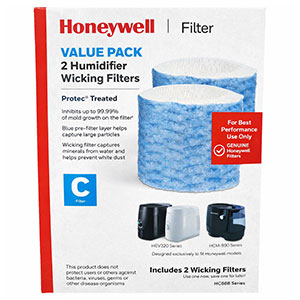
| Filter C | HC-888 / HC-888N | HEV-320 and HCM-890 Series | Formed wick engineered for the HEV-320 and HCM-890 housings. It differs dimensionally from Filter A and should not be substituted for HAC-504. |
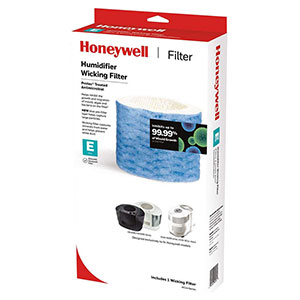
| Filter E | HC-14 / HC-14N | HEV-680 and HEV-685 Series / HCM-6009 / HCM-6011 | Large console-style wick made for higher-capacity humidifiers. Its wider structure and reservoir footprint are not compatible with smaller tabletop models. |
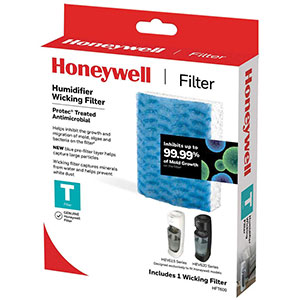
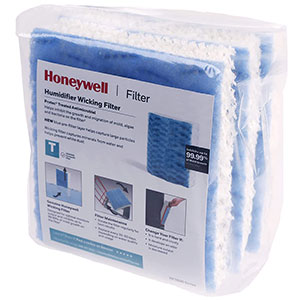
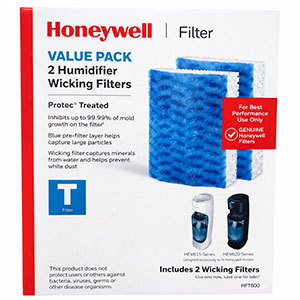
| Filter T | HFT600 | HEV-615 and HEV-620 Series | Tall tower-style wick designed specifically for HEV-615 and HEV-620 top-fill humidifiers. |
No. Wicking filters are used by evaporative cool-moisture humidifiers. Many ultrasonic and warm-mist Honeywell Humidifiers are filter-free, although an ultrasonic model may accept an optional demineralization cartridge or Protec cleaning cartridge.
A Protec cleaning cartridge is not a replacement for a wicking filter. It is a separate water-treatment accessory intended to help keep the tank fresher between cleanings.
Filter A and Filter C are both evaporative wicking filters, but they are designed for different humidifier families. Filter A, identified by HAC-504 or HAC-504AW, has broad compatibility across many HCM and HEV models. Filter C, identified by HC-888 or HC-888N, is designed primarily for the HEV-320 and HCM-890 series.
The two filters differ in height, width, curvature, pleat placement and how they sit in the reservoir. They should not be trimmed, compressed or reshaped to fit another humidifier.
Filter E is a significantly larger console-style wick used by high-capacity humidifiers such as the HEV-680, HEV-685, HCM-6009 and HCM-6011. Its large reservoir footprint provides more surface area for console humidification.
Filter E cannot replace Filter A or Filter C. Even if another wick can be physically placed inside the console, it may not reach the correct water depth or create the required seal and airflow path.
Filter T is a tall, narrow wick built for the internal tower configuration of the HEV-615 and HEV-620. Its HFT600 part number is unique to this filter family. HFT600 should not be listed or sold as Filter A.
An incorrect wick may appear close enough in size but still prevent the humidifier from operating properly. Possible problems include:
If the base begins leaking or overflowing after a filter change, turn off and unplug the humidifier. Verify the filter letter, tank alignment, float position and valve operation before using the unit again.
The typical replacement interval is every 30–60 days. However, how often to change Honeywell humidifier filter media depends on water hardness, daily runtime, output setting and whether the wick remains evenly saturated.
The calendar is only a guideline. Replace the filter whenever its condition or the humidifier’s performance indicates that the wick has reached the end of its useful life.
A Honeywell wicking filter that becomes hard or yellow has usually collected minerals and other impurities from the water. This is especially common in homes with hard water. As water evaporates, calcium and other dissolved minerals remain inside the filter fibers and gradually solidify.
Yellow or brown discoloration alone does not always mean the filter contains mold. Mineral content can change the wick’s color. Replace it when discoloration is accompanied by stiffness, crusting, odor, physical damage or reduced moisture output.
A clean wick contains open pathways that draw water upward while allowing air to pass through. Mineral scale blocks those pathways. The filter absorbs water more slowly, less wet surface area remains available for evaporation, and airflow through the wick becomes restricted.
The fan may sound normal even though the humidifier releases less moisture. Installing a new compatible wick usually restores water absorption and airflow when a hardened filter is the cause.
The exact disassembly procedure varies by model, but most Honeywell evaporative humidifiers use the following basic process:
If the housing does not close easily after replacement, do not force it. Recheck the filter letter, dimensions and installation orientation.
No. A Honeywell wicking filter should not be washed with soap, detergent, vinegar, bleach or another chemical cleaner. These products can damage the filter media, interfere with its antimicrobial treatment and reduce its ability to wick water properly.
A hardened filter may be soaked or gently rinsed in cool water if the owner’s manual permits it. This may loosen some mineral buildup temporarily, but it does not restore a worn filter to new condition. Replace the filter when it remains stiff or performance has declined.
No. Remove the filter before descaling the humidifier with vinegar or disinfecting the tank with diluted bleach. Wicking filters cannot be descaled or disinfected using these chemicals without risking damage to the filter structure.
No. Let excess water drain naturally. Wringing, squeezing or twisting the filter can crush its internal channels, distort its shape and reduce the airflow needed for evaporation.
No. Wicking filters are designed around the humidifier’s reservoir depth and airflow path. Cutting or compressing a different filter can produce low output, unstable seating, air bypass or interference with the tank and float system.
No. Yellow, tan or brown discoloration is often caused by minerals and other substances in the water. Replace the filter if the discoloration is accompanied by odor, slime, visible growth, stiffness or reduced performance.
The top of a wick can dry faster than the portion sitting in the reservoir. Flipping the filter top-to-bottom with each refill places the drier section closer to the water and helps the filter age more evenly.
Flipping does not eliminate the need for replacement. It is a maintenance step that can reduce uneven drying while the filter remains within its normal service life.


Explore related support articles and resources for this topic.
Find Honeywell humidifier setup, cleaning, filter, water, indicator light, white dust, buying, and troubleshooting guides for common models and types.
Contact options may differ depending on the type of help you need.