When checking out, simply select the "New Customer" option. All you need to get started is a valid email address and a secure password of your choosing. After your purchase is complete, your account will be created, and you will immediately gain all the benefits of being an account holder. If you have previously placed an order with us as a guest, you can try using the "Forgot Password" feature under the "Sign In" tab.
Benefits of having an account:
Real-time status updates on all your orders and returns.
Ability to view detailed order history.
Eligibility to enroll in subscription items for recurring discounts.
Access to more store features and quicker customer support.
Connection to a dedicated sales representative if placing bulk orders.
Manage your account settings:
Update your email address and password.
Unsubscribe from email promotions.
Manage item subscriptions.
Delete your account and remove your information.
We respect your privacy and are committed to protecting any personal information you may provide us through our Website. View our privacy policy for more info.
How to Use a Honeywell Air Purifier During Wildfire Smoke
Wildfire smoke can travel hundreds or even thousands of miles from an active fire, enter homes through small openings, and quickly reduce indoor air quality. A properly sized Honeywell air purifier can help lower the concentration of airborne smoke particles inside a closed room, particularly when it combines True HEPA particle filtration with an activated carbon pre-filter.
This guide explains how to choose and operate a Honeywell air purifier for smoke, which filters target particles and odors, which settings to use when the outdoor Air Quality Index rises, and how wildfire conditions may shorten filter life.
Important Wildfire Safety Reminder
An air purifier can help reduce indoor smoke particles, but it cannot make every home safe during a wildfire emergency. Follow evacuation orders and instructions from local authorities. If your home becomes too smoky, too hot, loses power, or cannot be kept safely closed, move to a cleaner-air shelter or another suitable location.
Why Wildfire Smoke Is a Two-Part Air-Quality Threat
Wildfire smoke is not a single contaminant. It is a complex mixture of fine particles and gases produced as trees, vegetation, buildings, furnishings, plastics, and other materials burn.
Threat 1: Fine PM2.5 Smoke Particles
PM2.5 refers to airborne particulate matter measuring 2.5 microns in diameter or smaller. These particles are roughly 30 times smaller than the diameter of a human hair and can be inhaled deeply into the lungs. PM2.5 is the principal wildfire-smoke pollutant tracked by public air-quality agencies because of its potential effects on the lungs and cardiovascular system.
Wildfire PM2.5 may include microscopic soot, condensed organic compounds, and other fine combustion particles. Much of this material is too small to see individually even when the outdoor air appears hazy.
Threat 2: VOCs and Other Gaseous Pollutants
Wildfire smoke also contains gaseous pollutants, including volatile organic compounds, commonly called VOCs. These gases contribute to the sharp, acrid odor associated with smoke and can participate in atmospheric reactions that create additional pollutants. A particle filter alone does not remove all gases, which is why carbon filtration is an important second layer.
Wildfire Smoke Particle and Gas Comparison
Smoke Component
Common Examples
Primary Honeywell Filter Layer
Fine particles
PM2.5, microscopic soot and airborne smoke particles
True HEPA Filter R
Larger airborne debris
Visible dust, fibers and larger ash particles entering the purifier
Carbon Pre-Filter A
Odors and certain gases
Smoke odor and some VOCs
Activated Carbon Pre-Filter A or another compatible enhanced odor filter
No portable air purifier removes every gas found in wildfire smoke. Carbon media can help reduce certain odors and VOCs, but its effectiveness depends on the amount and type of carbon, airflow, pollutant concentration, and remaining adsorption capacity.
Honeywell's Two-Stage Defense Against Wildfire Smoke
Many Honeywell HPA, InSight®, and PowerPlus® air purifiers use a layered system consisting of an activated carbon pre-filter followed by one or more True HEPA filters. Each layer addresses a different part of the wildfire-smoke problem.
Filter A and Filter R: How the Two Layers Work
Stage 1: Honeywell Carbon Pre-Filter A
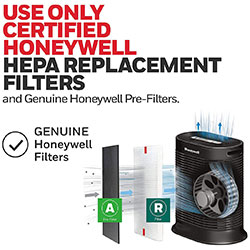
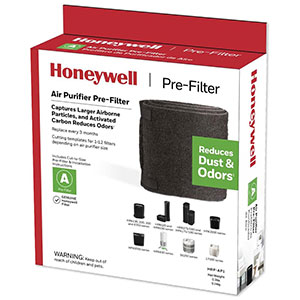
Honeywell Filter A, including the HRF-AP1, sits in front of the main HEPA filter. It traps larger airborne material such as dust, lint, fibers, and pet fur while helping reduce household odors from sources that include smoke.
The activated carbon works primarily through adsorption. Odor-producing molecules adhere to the carbon's porous surface as air moves through the pre-filter. This differs from absorption, where a substance is taken into another material.
Stage 2: Honeywell True HEPA Filter R
Honeywell Filter R mechanically captures up to 99.97% of airborne particles measuring 0.3 microns from the air that passes through the filter. It is used in popular Honeywell console and InSight product families, including HPA100, HPA200, HPA300, HPA3100–HPA3300, and HPA5100–HPA5300 series models.
Because wildfire PM2.5 consists of particles measuring 2.5 microns and smaller, a correctly installed True HEPA filter is an important tool for capturing fine airborne smoke particles as the purifier repeatedly circulates the room's air.
Why Both Filter Layers Matter
The True HEPA filter is the primary defense against physical smoke particles, but it does not perform the same job as activated carbon. The carbon pre-filter helps manage odor-producing gases while also protecting the HEPA filter from larger debris.
For the best overall smoke performance, confirm that both filters are installed, are compatible with your purifier, and are not sealed inside their protective shipping bags. Use Genuine and Certified Honeywell replacement filters to maintain the intended fit, airflow, and tested system performance.
Choosing the Best Air Purifier for Wildfire Smoke
The best air purifier for wildfire smoke is not simply the largest model available. It should be appropriately sized for the enclosed room, offer strong smoke CADR performance, and use filters capable of addressing both particles and odors.
Wildfire Smoke Buying Checklist
True HEPA filtration: Look for a model that captures up to 99.97% of particles at 0.3 microns from air passing through the filter.
Activated carbon: Choose a model with a carbon pre-filter to help reduce smoke odors and certain VOCs.
Adequate room coverage: Match the purifier's certified square-foot rating to the enclosed space where it will operate.
High smoke CADR: A higher smoke Clean Air Delivery Rate means the purifier can deliver more filtered air per minute.
Multiple fan speeds: Turbo and high-speed settings are useful when smoke levels rise quickly.
Available replacement filters: Keep at least one replacement pre-filter available during wildfire season.
A small purifier placed in a large open-concept space may complete too few air changes per hour to keep pace with continuing smoke infiltration. Creating one enclosed clean-air room can be more effective than trying to clean an entire home with an undersized unit.
How to Clear Wildfire Smoke From Your House
During an active smoke event, the goal is to limit how much outdoor smoke enters the home and continuously filter the air that is already indoors.
Immediate Wildfire Smoke Response
Check current conditions: Monitor the Air Quality Index and local smoke forecast using AirNow or your state air-quality agency.
Close windows and exterior doors: Reduce outdoor smoke infiltration as much as practical.
Create a clean-air room: Choose a bedroom or other enclosed room where household members can remain comfortable.
Run the portable air purifier continuously: AirNow advises that portable air cleaners work best during wildfire smoke when operated continuously with windows and doors closed.
Set central HVAC to recirculate: Close any fresh-air intake and use an appropriately rated HVAC filter if the system supports it.
Avoid creating indoor particles: Limit frying, smoking, burning candles, sweeping, and ordinary vacuuming during severe smoke conditions.
Keep the room safely cool: Do not allow a closed clean-air room to become dangerously hot.
Should You Run Your Air Purifier on Turbo for Smoke?
Yes. When outdoor AQI rises or smoke has entered the room, begin with Honeywell Turbo Mode to maximize airflow through the filters. Turbo is the highest cleaning level on compatible models and is designed to clean the air and reduce odors and VOCs more quickly than lower settings.
Recommended Wildfire Smoke Air Purifier Settings
Close the room's windows and exterior doors.
Confirm that the intake and outlet vents have open clearance.
Select Turbo Mode for the first 30 to 60 minutes as a practical initial cleaning period.
After the initial period, evaluate the room and outdoor AQI conditions.
Continue on Turbo if smoke is still entering, the room remains hazy, or outdoor conditions are severe.
If conditions have stabilized, reduce the purifier to Allergen, Pollen, or another high manual setting.
Keep the purifier running continuously while the smoke event remains active.
The 30-to-60-minute period is a practical starting point, not a guaranteed room-clearance time. Actual cleaning speed depends on the purifier's smoke CADR, room volume, fan setting, filter condition, and amount of smoke entering the space.
Should You Use Auto Mode for Wildfire Smoke?
Auto Mode may be helpful for changing VOC levels, but it should not be the only control strategy during a heavy smoke event. Honeywell InSight Auto Mode responds to its built-in VOC sensor, which detects certain gases. It is not a dedicated PM2.5 particle monitor.
Because wildfire PM2.5 may remain high even when the VOC indicator changes color, selecting Allergen, Pollen, or Turbo manually provides more predictable airflow. Use Auto Mode after conditions improve or when you want the purifier to react to VOC fluctuations.
Where to Place the Air Purifier During a Smoke Event
Place the purifier in the enclosed room where people are spending the most time. Keep its intake and exhaust away from walls, curtains, bedding, and large furniture so air can move freely through the unit.
Wildfire Smoke Placement Rules
Place the purifier in the clean-air room rather than an open hallway.
Keep it near the occupied area while maintaining safe airflow clearance.
Do not hide it behind a couch, television, curtain, or closed furniture.
Do not place the purifier directly against a leaking window as a substitute for sealing the opening.
Close and seal obvious gaps when it can be done safely.
Keep the purifier away from open flames, excessive moisture, and heat sources.
The purifier should circulate the room's air—not intentionally draw more outdoor smoke through a poorly sealed opening.
Wildfire Smoke Filter Maintenance
Wildfire events expose air-purifier filters to much higher pollutant concentrations than ordinary household use. Honeywell normally recommends replacing Filter A every three months and Filter R approximately once per year, but these are general intervals. Honeywell notes that high concentrations of contaminants such as smoke reduce useful filter performance.
Smoke Event Maintenance Checklist
Inspect the carbon pre-filter after prolonged or severe smoke exposure.
Replace the pre-filter early if smoke odor returns quickly or remains after extended operation.
Check for visible soot or heavy darkening on the pre-filter.
Replace a HEPA filter early if airflow remains weak after the pre-filter is changed.
Never wash, vacuum, or blow compressed air through disposable Filter A or Filter R media.
Reset the appropriate filter timer only after inspecting or replacing the filter.
Keep spare certified filters sealed in their packaging until needed.
Why the Smoke Smell May Return
Activated carbon has a limited adsorption capacity. Once its available surface becomes loaded with odor-producing molecules, it can no longer reduce smoke odor as effectively. A pre-filter used during several days of severe wildfire smoke may therefore require replacement before its normal three-month interval.
A lingering odor does not necessarily mean the HEPA filter has failed. The HEPA layer targets particles, while the carbon layer is primarily responsible for odor and gas reduction.
What an Air Purifier Cannot Do During a Wildfire
It cannot prevent all outdoor smoke from entering a building.
It cannot remove every gas or chemical present in wildfire smoke.
It cannot replace an evacuation order.
It cannot clean rooms effectively when it is significantly undersized.
It cannot compensate for open windows, blocked vents, or exhausted filters.
It cannot serve as a carbon-monoxide alarm or combustible-gas detector.
People with asthma, heart disease, lung disease, or other health concerns should follow advice from their healthcare provider during smoke events. Children, older adults, pregnant people, and individuals with heart or breathing conditions may be more vulnerable to wildfire-smoke exposure.
Frequently Asked Questions
How fast can an air purifier clean a smoky room?
Cleaning time depends on room volume, the purifier's smoke CADR, fan speed, filter condition, placement, and continuing smoke infiltration. Start on Turbo and run the purifier continuously. A visible haze or strong odor may take considerably longer than 30 to 60 minutes to improve, especially while outdoor AQI remains elevated.
Can an electronic ifD® filter handle heavy wildfire smoke?
Compatible Honeywell AirGenius and QuietClean ifD® models can help capture airborne smoke particles that pass through their permanent washable filters. For any purifier, compare its certified smoke CADR and room-size rating rather than relying only on the filter name. During heavy smoke, inspect and clean a washable ifD® filter more frequently, then allow it to dry completely before reinstalling it.
Should I place my air purifier near the window where smoke is leaking in?
First close and seal the window as much as safely possible. Place the purifier within the clean-air room where its intake and outlet remain unobstructed. Do not position it in a way that encourages additional outdoor air to enter through the leak.
Does a True HEPA filter remove the smell of wildfire smoke?
A True HEPA filter captures airborne smoke particles but is not designed primarily for gases or odors. An activated carbon pre-filter is needed to help adsorb certain odor-producing gases and VOCs. Even with carbon filtration, no portable purifier removes every gaseous component of wildfire smoke.
How long should I run my air purifier after the outdoor smoke clears?
Continue running the purifier until local AQI improves, windows can safely be reopened, and indoor air no longer appears or smells smoky. Keeping it on a high setting for several additional hours can help capture particles that remain suspended or become disturbed from indoor surfaces.
Why is my Honeywell filter light turning on early during wildfire season?
Honeywell filter reminders are based primarily on accumulated operating time, and continuous high-speed use can reach the reminder interval sooner. Heavy smoke also loads filtration media more quickly. Inspect the filter rather than resetting the light automatically, and replace it if airflow or odor reduction has declined.
Can one air purifier protect my entire house from wildfire smoke?
Usually not unless the unit and building layout are specifically designed for whole-home filtration. Portable purifiers work most effectively in enclosed rooms that match their certified coverage. During severe smoke, use one or more correctly sized purifiers or concentrate on creating a dedicated clean-air room.
Should I open the windows once the room smells better?
Check the current outdoor AQI before opening windows. A reduced indoor odor does not prove that outdoor smoke levels are safe. Keep windows and doors closed while local smoke conditions remain unhealthy, unless opening them is necessary to address dangerous indoor heat or another immediate safety concern.
Explore Honeywell air purifier guides to troubleshoot common questions, find compatible replacement filters, and create a cleaner and more comfortable indoor environment.
Contact options may differ depending on the type of help you need.
Cookie Preferences
This site uses a small number of cookies to provide a secure and reliable shopping experience.
Required cookies are set directly by this site and are used only for essential store functions such as maintaining your shopping cart, processing checkout, providing security, and keeping the site working properly. We also use optional Google cookies for website analytics and advertising measurement. You can choose whether to allow these Google cookies below.
Required Cookies
These cookies are necessary for essential website functions, including your shopping cart, checkout, site security, and maintaining your shopping session. These cookies are set directly by this site and cannot be disabled.
Always Active
Google Analytics & Advertising Cookies
We use Google services to understand how customers use this site, improve site performance and navigation, and measure the effectiveness of our advertising. These cookies are optional. Turning them off will not affect your ability to browse, shop, or complete an order.
Learn more about how we protect your information in our Privacy Policy.