When checking out, simply select the "New Customer" option. All you need to get started is a valid email address and a secure password of your choosing. After your purchase is complete, your account will be created, and you will immediately gain all the benefits of being an account holder. If you have previously placed an order with us as a guest, you can try using the "Forgot Password" feature under the "Sign In" tab.
Benefits of having an account:
Real-time status updates on all your orders and returns.
Ability to view detailed order history.
Eligibility to enroll in subscription items for recurring discounts.
Access to more store features and quicker customer support.
Connection to a dedicated sales representative if placing bulk orders.
Manage your account settings:
Update your email address and password.
Unsubscribe from email promotions.
Manage item subscriptions.
Delete your account and remove your information.
We respect your privacy and are committed to protecting any personal information you may provide us through our Website. View our privacy policy for more info.
Choosing the right air purifier is about more than finding a unit that fits neatly in the room. The purifier must be powerful enough to circulate and filter the room's air several times per hour. A model that is too small may run continuously without removing airborne particles as quickly as you expect, while a properly sized model can provide faster, more consistent filtration.
This Honeywell air purifier sizing guide explains how Clean Air Delivery Rate, room square footage and air changes per hour work together. Use it to compare Honeywell air purifiers for bedrooms, offices, living rooms, basements and other spaces throughout your home.
Start by Measuring Your Room
Before comparing air purifiers, calculate the square footage of the room you want to clean. For a rectangular or square room, multiply the room's length by its width.
Room Square-Footage Formula
Room length × room width = total square footage
For example, a bedroom that measures 12 feet long by 14 feet wide has a total area of 168 square feet:
12 × 14 = 168 sq. ft.
Choose an air purifier rated for at least 168 square feet at the manufacturer's stated air-change rate. Selecting a model with slightly more capacity can provide faster cleaning, quieter operation at lower fan speeds and additional performance during allergy or wildfire-smoke events.
What Is CADR?
CADR stands for Clean Air Delivery Rate. It measures the volume of filtered air an air purifier delivers each minute and is expressed in cubic feet per minute, or CFM. A higher CADR generally means the purifier can remove airborne particles more quickly in an appropriately sized room.
AHAM Verifide air purifiers are independently tested and assigned three separate CADR ratings:
Tobacco Smoke CADR: Measures performance against smaller smoke particles.
Dust CADR: Measures the removal of common airborne household dust.
Pollen CADR: Measures performance against larger particles such as pollen.
These ratings make it easier to compare air purifiers using standardized performance measurements rather than relying only on marketing claims.
Understanding the CADR 2/3 Rule
AHAM recommends choosing an air cleaner with a tobacco-smoke CADR equal to at least two-thirds of the room's square footage. For wildfire smoke, AHAM recommends selecting a smoke CADR approximately equal to the room's square footage.
For everyday particle filtration, look for a purifier with a smoke CADR of approximately 134 or higher. Choosing a model with a higher rating may clean the room more rapidly.
What Are Air Changes Per Hour?
Air Changes Per Hour, commonly abbreviated as ACH, estimates how many times an air purifier can circulate and filter the air in a defined room during one hour. ACH depends on the purifier's airflow, the room's floor area and the ceiling height.
Many Honeywell room-size recommendations are based on the purifier circulating and filtering the air up to 4.8 times per hour in the specified room size. That equals approximately one air circulation every 12.5 minutes when the unit is operated at its tested setting. For example, the HPA100 is rated for 4.8 air changes per hour in a 155-square-foot room, while the HPA300 is rated for 4.8 air changes per hour in a 465-square-foot room.
Why ACH Matters
A correctly sized purifier can repeatedly filter the room's air throughout the day.
A small-room purifier placed in a large room will complete fewer air changes per hour.
Lower ACH means smoke, pollen, dust and pet dander may remain suspended longer.
Higher fan speeds generally provide faster filtration but may create more operating noise.
High ceilings increase the room's air volume and may require a larger purifier.
When comparing coverage claims, always check the number of air changes associated with the listed square footage. Some large coverage numbers are based on only one air change per hour rather than the faster 4.8-ACH room rating.
Honeywell Air Purifiers for Small Rooms
Recommended Room Size: Up to 100 Square Feet
Honeywell air purifiers for small rooms are well suited for compact bedrooms, home offices, nursery spaces, dorm rooms and small guest rooms. Tabletop models take up less space and can often be placed on a sturdy desk, dresser or nightstand while maintaining the clearance specified in the product manual.
Small-Room Buying Checklist
Look for coverage of approximately 90 to 100 square feet at the stated ACH.
Choose a smoke CADR of at least 60 to 67 for a room near 90 to 100 square feet.
Consider tabletop dimensions if floor space is limited.
Compare operating noise if the purifier will be used while sleeping or working.
Confirm that replacement filters are readily available.
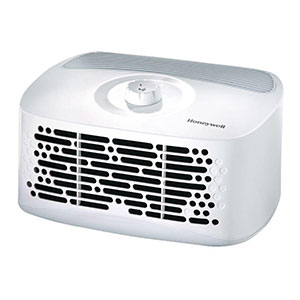
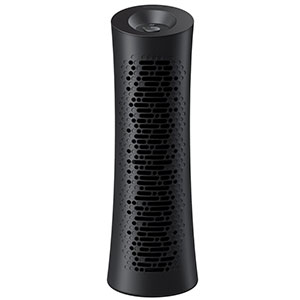
The Honeywell HPA020B, for example, is classified for a small room of approximately 90 square feet.
Honeywell Air Purifiers for Bedrooms & Medium Rooms
Recommended Room Size: 100 to 250 Square Feet
This range includes many standard bedrooms, kitchens, offices and smaller family rooms. Honeywell air purifiers for bedrooms should provide enough CADR for the entire room while also offering fan settings suitable for quieter overnight operation.
Bedroom and Medium-Room Options
100-square-foot room: Look for a smoke CADR of at least 67.
150-square-foot room: Look for a smoke CADR of at least 100.
200-square-foot room: Look for a smoke CADR of at least 134.
250-square-foot room: Look for a smoke CADR of at least 167.
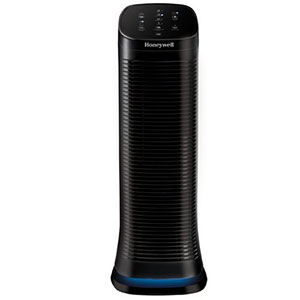
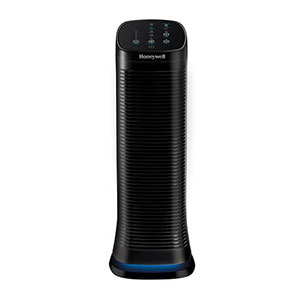
The HPA100 is rated for approximately 155 square feet at 4.8 air changes per hour. The HPA030B tower model is rated for approximately 200 square feet and has published CADR ratings of 110 for tobacco smoke, 124 for dust and 117 for pollen.
Choosing an Air Purifier for Sleep
For overnight use, choose a model that is appropriately sized at a moderate fan setting rather than relying on Turbo mode all night. A purifier with extra capacity may be able to maintain filtration at a lower and quieter speed after initially cleaning the room at a higher setting.
Place the purifier where the air intake and outlet remain unobstructed. Avoid hiding it behind furniture, pressing it against curtains or positioning the clean-air outlet directly toward your face.
Honeywell Air Purifiers for Large Rooms
Recommended Room Size: 250 to 500+ Square Feet
Honeywell air purifiers for large rooms are designed for living rooms, primary bedrooms, finished basements and open-concept areas. These models use higher airflow and larger filter assemblies to process more air each minute.
Large and Extra-Large Room Options
300-square-foot room: Look for a smoke CADR of at least 200.
400-square-foot room: Look for a smoke CADR of at least 267.
465-square-foot room: Look for a smoke CADR of at least 310.
500-square-foot room: Look for a smoke CADR of at least 335.
The Honeywell HPA300 is rated to circulate and filter air up to 4.8 times per hour in a 465-square-foot room. The HPA5300B InSight Series is rated for up to 4.8 air changes per hour in a 500-square-foot room.
Sizing for Open-Concept Areas
Measure the full connected space when walls and doors do not separate the rooms. For example, if a living room, dining room and kitchen share open pathways, calculate the combined square footage rather than measuring only the area where the purifier will sit.
Air circulation can be affected by furniture, partial walls, hallways and room shape. In a large or irregular open-concept area, a larger purifier or two strategically placed units may provide more consistent coverage than one smaller model.
Honeywell Air Purifier Room-Size Chart
Quick-Reference CADR and Room Sizing
Room Type
Recommended Square Footage
Minimum Smoke CADR Using the 2/3 Rule
Typical Honeywell Series or Models
Small office, nursery or compact guest room
Up to 100 sq. ft.
Up to approximately 67
Tabletop models, including HPA020B
Standard bedroom or home office
100–175 sq. ft.
Approximately 67–117
HPA100 Series and comparable medium-room models
Large bedroom, kitchen or medium living area
175–250 sq. ft.
Approximately 117–167
Tower models, including HPA030B, and comparable units
Family room or finished basement
250–400 sq. ft.
Approximately 167–267
Large-room Honeywell console models
Large living room or open-concept area
400–500+ sq. ft.
Approximately 267–335+
HPA300, HPA5300B InSight Series and comparable extra-large-room models
Important: Model availability, CADR ratings and room-size certifications vary. Review the current product specifications for the exact Honeywell model before purchasing.
Should You Choose a Larger Air Purifier?
Buying a purifier rated for a somewhat larger room is generally acceptable. In a smaller space, the unit may circulate the air more frequently or achieve the desired filtration at a lower fan setting. This can be helpful when managing heavy pollen, pet dander, smoke or other elevated particle levels.
However, larger models usually require more floor space, may use larger filter sets and can produce more sound at maximum speed. Compare the purifier's dimensions, replacement-filter costs and sound settings along with its CADR.
Factors That Can Change the Size You Need
Ceiling height: Standard room ratings generally assume an 8-foot ceiling. Higher ceilings create more air volume.
Open doorways: Air can move into adjacent halls or rooms, increasing the effective cleaning area.
Room shape: Alcoves, partial walls and L-shaped layouts may reduce uniform circulation.
Pollution level: Smoke, pets, heavy dust or seasonal pollen may justify additional capacity.
Placement: Blocked intake or outlet vents can prevent a correctly sized purifier from delivering its rated performance.
Frequently Asked Questions
Can I use a large-room air purifier in a small room?
Yes. A large-room purifier can be used in a smaller room and may clean the air more frequently or allow you to use a lower fan speed. Make sure the unit fits comfortably, has adequate airflow clearance and does not create more noise than you prefer.
What happens if my ceiling is higher than 8 feet?
Higher ceilings increase the total volume of air in the room, so square footage alone may underestimate the purifier capacity you need. AHAM recommends choosing an air cleaner rated for a larger room when ceilings are higher than 8 feet.
How do I calculate the square footage of an L-shaped room?
Divide the L-shaped room into two rectangular sections. Multiply the length by the width of each section, then add the two results together. Use the combined square footage when selecting your air purifier.
Can one air purifier clean multiple rooms?
An air purifier works best in one defined room with relatively unobstructed airflow. Doorways, hallways and walls reduce circulation between rooms. For consistent filtration, consider a separate purifier for each frequently occupied bedroom or living area.
Is square-foot coverage or CADR more important?
Both are useful, but CADR provides a standardized measure of how much filtered air the purifier delivers. Use the model's certified room size and air-change rate for an easy comparison, then confirm that its smoke CADR follows the 2/3 rule for your room.
Should I size my purifier for wildfire smoke differently?
Yes. For wildfire smoke, AHAM recommends a smoke CADR equal to approximately the room's square footage rather than only two-thirds of its area. A 200-square-foot room would therefore benefit from a smoke CADR near 200.
What if my room falls between two purifier sizes?
Choose the larger model when possible, especially if the room has high ceilings, open doorways, pets, smoke or heavy allergy concerns. Extra capacity gives you more flexibility to clean the room faster or operate the purifier at a quieter setting.
Explore Honeywell air purifier guides to troubleshoot common questions, find compatible replacement filters, and create a cleaner and more comfortable indoor environment.
Contact options may differ depending on the type of help you need.
Cookie Preferences
This site uses a small number of cookies to provide a secure and reliable shopping experience.
Required cookies are set directly by this site and are used only for essential store functions such as maintaining your shopping cart, processing checkout, providing security, and keeping the site working properly. We also use optional Google cookies for website analytics and advertising measurement. You can choose whether to allow these Google cookies below.
Required Cookies
These cookies are necessary for essential website functions, including your shopping cart, checkout, site security, and maintaining your shopping session. These cookies are set directly by this site and cannot be disabled.
Always Active
Google Analytics & Advertising Cookies
We use Google services to understand how customers use this site, improve site performance and navigation, and measure the effectiveness of our advertising. These cookies are optional. Turning them off will not affect your ability to browse, shop, or complete an order.
Learn more about how we protect your information in our Privacy Policy.