When checking out, simply select the "New Customer" option. All you need to get started is a valid email address and a secure password of your choosing. After your purchase is complete, your account will be created, and you will immediately gain all the benefits of being an account holder. If you have previously placed an order with us as a guest, you can try using the "Forgot Password" feature under the "Sign In" tab.
Benefits of having an account:
Real-time status updates on all your orders and returns.
Ability to view detailed order history.
Eligibility to enroll in subscription items for recurring discounts.
Access to more store features and quicker customer support.
Connection to a dedicated sales representative if placing bulk orders.
Manage your account settings:
Update your email address and password.
Unsubscribe from email promotions.
Manage item subscriptions.
Delete your account and remove your information.
We respect your privacy and are committed to protecting any personal information you may provide us through our Website. View our privacy policy for more info.
The Science Behind Honeywell Air Purifier Technology
Honeywell air purifiers use a carefully controlled airflow cycle to draw polluted room air into the unit, move it through one or more filtration layers, and return filtered air to the surrounding space. Depending on the model, the primary particle-capture technology may be a replaceable True HEPA filter or Honeywell's permanent, washable ifD® electronic filtration system.
Understanding how a Honeywell air purifier works can help you choose the right model, position it correctly, maintain its filters, and get better long-term performance from the unit.
How Does an Air Purifier Clean the Air?
An air purifier does not clean an entire room instantaneously. It repeatedly circulates the room's air through an internal filtration system. Each pass gives the purifier another opportunity to capture airborne dust, pollen, smoke particles, pet dander, mold spores, and other contaminants.
The Honeywell Airflow Cycle
Air intake: A motor-driven fan creates a pressure difference that pulls room air through the purifier's front, rear, side, or bottom intake grilles.
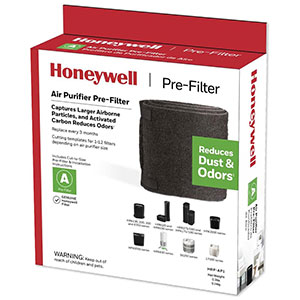
Pre-filtration: The incoming air may first pass through a pre-filter that captures larger debris such as lint, hair, fibers, and visible dust. Carbon-treated pre-filters can also help reduce certain household odors and volatile organic compounds.
Primary particle filtration: The air then moves through either a True HEPA filter or an electrically powered ifD® collection filter, depending on the model.
Clean-air exhaust: The fan releases the filtered air through the outlet vents and back into the room.
Continuous recirculation: As the purifier continues operating, it repeatedly processes more of the room's air.
The air leaving the purifier has passed through its filtration system, but no portable purifier can guarantee that every particle in a room will immediately pass through the unit. Room size, fan speed, placement, open doors, ceiling height, and blocked vents all affect real-world performance.
How Honeywell True HEPA Air Purifiers Work
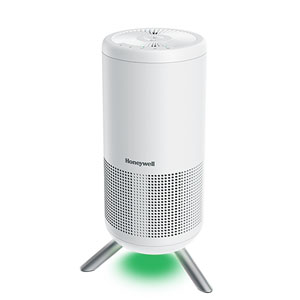
Honeywell HPA Series air purifiers use traditional mechanical filtration. Air is physically pushed through a dense, pleated filter containing a web of fine fibers. Instead of acting like a simple screen with uniformly sized holes, a True HEPA filter captures particles through several overlapping scientific mechanisms.
A HEPA filter is defined as a pleated mechanical air filter capable of theoretically removing at least 99.97% of airborne particles measuring 0.3 microns. The 0.3-micron size is used because it is near the filter's most penetrating and difficult-to-capture particle range—not because smaller particles always pass through.
The Three Primary HEPA Capture Mechanisms
1. Impaction
Larger particles have greater mass and momentum. As the airflow bends around a filter fiber, particles such as heavier dust cannot change direction quickly enough. They collide directly with the fiber and become trapped.
2. Interception
Medium-sized particles may follow the airflow around the fibers, but some pass close enough to touch a fiber. Once contact occurs, surface forces cause the particle to stick instead of continuing through the filter.
3. Diffusion
Very small particles are constantly struck by surrounding air molecules. This produces an irregular zigzag movement known as Brownian motion. The unpredictable movement increases the likelihood that a tiny particle will contact and adhere to a filter fiber. EPA filtration research identifies impaction, interception, and diffusion as key mechanical particle-capture processes.
Why a HEPA Filter Is More Than a Fine Screen
A common misconception is that HEPA media works only by blocking particles larger than its openings. In reality, the twisting airflow path and the three capture mechanisms allow the filter to collect particles both larger and smaller than 0.3 microns.
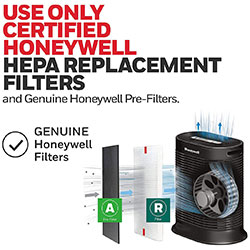
Honeywell True HEPA air purifiers commonly pair the main filter with a carbon pre-filter. The pre-filter captures larger debris and helps reduce odors before the air reaches the more delicate HEPA media.
What Is Honeywell ifD® Technology?
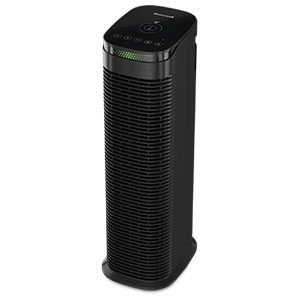
Honeywell ifD® technology is an electronically assisted particle-filtration system used in select AirGenius and QuietClean air purifiers. Unlike conventional Honeywell HPA models, these units use a permanent primary filter that can be washed and reused according to the product's care instructions.
The term ifD® refers to an intensified field dielectric filtration system. Rather than relying only on a dense paper-like fiber mat, it uses electrical energy to help charge and capture airborne particles.
How the ifD® Filtration Process Works
Room air enters the purifier: The internal fan pulls contaminated air through the intake grille and pre-filter.
Electrical charging occurs: The system uses electrical power to create ions that attach to particles suspended in the room air.
Charged particles return to the purifier: Normal room circulation and the purifier's intake airflow draw these particles back toward the unit.
The ifD® filter captures them: The particles pass into the electrically charged ifD® filter and adhere to its collection structure.
The filter is reused: When sufficient debris accumulates, the permanent ifD® filter can be removed, washed, completely dried, and returned to the purifier.
Honeywell states that select AirGenius ifD® models can capture up to 99.9% of specified microscopic airborne particles from the air passing through the filter. Exact particle-size claims vary by model, so shoppers should review the specifications for the individual purifier.
Why ifD® Filters Are Washable
A True HEPA filter relies on delicate disposable fiber media that can be damaged by water. The ifD® collection system instead uses a durable filter assembly designed to be rinsed or washed according to the owner's manual.
AirGenius and QuietClean models may also include a washable foam pre-filter or an optional replaceable odor-reducing pre-filter. The odor-reducing Honeywell Filter K is not washable and should be replaced according to its maintenance schedule.
True HEPA vs. ifD® Filtration
Mechanical and Electronic Filtration Compared
Feature
True HEPA Filtration
ifD® Filtration
Common Honeywell product families
HPA Series and other True HEPA models
AirGenius and QuietClean models
Primary capture method
Mechanical impaction, interception, and diffusion
Electronically assisted charging and collection
Primary filter maintenance
Replace when required
Wash, dry completely, and reuse
Typical particle claim
Up to 99.97% at 0.3 microns for specified True HEPA models
Up to 99.9% for specified particle sizes, depending on model
Electronic particle charging
No, for mechanical-only models
Yes
Replacement-filter expense
Requires periodic replacement HEPA filters
Permanent primary filter; an optional odor pre-filter may require replacement
Neither technology is automatically the best choice for every household. True HEPA models may appeal to shoppers who prefer standardized mechanical filtration, while ifD® models provide the convenience of a permanent washable primary filter.
Do Honeywell ifD® Air Purifiers Produce Ozone?
Electronic air-cleaning technologies can generate small amounts of ozone as a byproduct, which is why shoppers often ask about Honeywell air purifier ionizer safety. It is important to distinguish a CARB-certified electronic air cleaner from an ozone generator intentionally designed to emit high ozone concentrations.
Understanding CARB Certification
Portable electronic air cleaners sold in California must be tested and certified under California Air Resources Board requirements. Electronic models must demonstrate ozone emissions no greater than 0.050 parts per million, or 50 parts per billion. CARB currently lists multiple Honeywell AirGenius models, including the HFD300, HFD310, HFD314, and HFD280 series, as certified electronic air-cleaning devices.
CARB certification does not mean that a device produces absolutely no ozone. It means the certified model was tested and found to meet California's ozone-emission limit. CARB also explains that certification addresses electrical safety and ozone compliance; it does not independently certify a purifier's pollutant-removal effectiveness or provide a blanket guarantee of health safety.
Consumers should verify that the exact model number appears on CARB's current certified-device list, particularly when purchasing an electronic or ion-generating air purifier.
Electronic Air Cleaners Are Not Ozone Generators
CARB warns against ozone generators that intentionally produce high ozone levels for indoor treatment. These products are fundamentally different from certified electronic air purifiers designed to remain within California's regulated emission limit.
What Each Filtration Layer Does
A Layer-by-Layer Look at Air Cleaning
Washable or Disposable Pre-Filter
The first layer captures larger material such as hair, lint, fibers, and visible dust. This helps keep the primary particle filter from becoming loaded too quickly.
Activated Carbon or Odor-Reducing Layer
Activated carbon adsorbs certain odor-producing gases and volatile organic compounds onto its porous surface. Carbon does not perform the same job as a HEPA filter and does not capture every gas or odor indefinitely.
True HEPA or ifD® Primary Filter
This is the principal particle-removal stage. True HEPA media captures particles through mechanical filtration, while an ifD® assembly uses electronically assisted collection.
Motor and Fan Assembly
The fan supplies the airflow needed to move room air through the filter. A highly efficient filter is only useful when the purifier can deliver enough airflow for the room, which is why CADR, proper sizing, clean filters, and unblocked vents all matter.
What Honeywell Air Purifiers Can and Cannot Do
Honeywell air purifiers can help reduce airborne particles that travel through their filtration systems. Depending on the model and installed pre-filter, they may also help reduce certain household odors and VOCs.
However, an air purifier does not remove particles already settled on floors and furniture, eliminate every gaseous pollutant, replace source control, or guarantee prevention of allergies or illness. For better indoor air quality, use filtration together with ventilation when appropriate, routine cleaning, humidity management, and removal of pollutant sources.
Frequently Asked Questions
Can a Honeywell air purifier run 24 hours a day?
Many Honeywell air purifiers can be operated continuously when used according to the owner's manual. Continuous operation provides repeated air filtration, although fan speed, noise, energy use, and filter life should also be considered. Honeywell's QuietClean instructions state that the unit may be run 24 hours a day when conditions warrant.
What is the difference between an activated carbon pre-filter and a True HEPA filter?
An activated carbon pre-filter helps capture larger debris and adsorb certain odors and gases. A True HEPA filter is the primary particle-filtration layer and is designed to capture microscopic airborne particles. The two filters perform different but complementary jobs.
Does an electronic ifD® filter kill bacteria or just trap it?
An ifD® filter is primarily described as a particle-capture system. Unless the specifications for a particular model make a separately tested microorganism-reduction claim, users should understand that captured particles are being collected rather than assume all bacteria are killed. Clean the permanent filter according to the owner's manual and wash your hands after handling dirty filtration components.
Are particles smaller than 0.3 microns too small for a HEPA filter?
Not necessarily. The 0.3-micron measurement represents a particularly challenging particle size for mechanical filtration. Smaller particles often move more erratically through Brownian diffusion, increasing their chances of contacting and sticking to a filter fiber.
Does a Honeywell air purifier bring fresh outdoor air into the room?
No. A portable air purifier generally recirculates and filters the air already inside the room. It does not provide outdoor ventilation unless it is part of a separate ventilation system.
Is an ifD® filter the same as a True HEPA filter?
No. They use different particle-capture mechanisms. True HEPA filters rely primarily on mechanical filtration through pleated fiber media, while ifD® technology uses electrical power to help charge and collect airborne particles on a permanent washable filter assembly.
Why does airflow become weaker as the filter gets dirty?
Accumulated dust and debris increase resistance through the filtration system. The fan must work against that restriction, which can reduce air output and cleaning performance. Replace disposable filters or clean washable filters according to the maintenance instructions for your model.
Explore Honeywell air purifier guides to troubleshoot common questions, find compatible replacement filters, and create a cleaner and more comfortable indoor environment.
Contact options may differ depending on the type of help you need.
Cookie Preferences
This site uses a small number of cookies to provide a secure and reliable shopping experience.
Required cookies are set directly by this site and are used only for essential store functions such as maintaining your shopping cart, processing checkout, providing security, and keeping the site working properly. We also use optional Google cookies for website analytics and advertising measurement. You can choose whether to allow these Google cookies below.
Required Cookies
These cookies are necessary for essential website functions, including your shopping cart, checkout, site security, and maintaining your shopping session. These cookies are set directly by this site and cannot be disabled.
Always Active
Google Analytics & Advertising Cookies
We use Google services to understand how customers use this site, improve site performance and navigation, and measure the effectiveness of our advertising. These cookies are optional. Turning them off will not affect your ability to browse, shop, or complete an order.
Learn more about how we protect your information in our Privacy Policy.