When checking out, simply select the "New Customer" option. All you need to get started is a valid email address and a secure password of your choosing. After your purchase is complete, your account will be created, and you will immediately gain all the benefits of being an account holder. If you have previously placed an order with us as a guest, you can try using the "Forgot Password" feature under the "Sign In" tab.
Benefits of having an account:
Real-time status updates on all your orders and returns.
Ability to view detailed order history.
Eligibility to enroll in subscription items for recurring discounts.
Access to more store features and quicker customer support.
Connection to a dedicated sales representative if placing bulk orders.
Manage your account settings:
Update your email address and password.
Unsubscribe from email promotions.
Manage item subscriptions.
Delete your account and remove your information.
We respect your privacy and are committed to protecting any personal information you may provide us through our Website. View our privacy policy for more info.
How to Use a Fan for Efficient Cooling & Air Circulation
Proper fan placement can make a room feel more comfortable, improve air circulation and reduce how heavily you rely
on air conditioning. The best way to use a portable fan depends on whether you want direct personal
cooling, whole-room circulation, outdoor-air ventilation or better distribution of conditioned air.
This guide explains how to use a fan for efficient cooling, including cross-ventilation, nighttime
exhaust, air-circulator positioning and energy-saving strategies for air-conditioned homes.
The Science of Fan Cooling
Fans primarily cool people, not the air itself. Moving air increases evaporation from the
skin and carries away body heat, producing a wind-chill effect that makes the same room temperature feel
more comfortable.
A fan running in a closed, empty room does not meaningfully lower the room’s air temperature.
The fan motor adds a small amount of heat to the room while operating.
Turn off a direct-comfort fan when everyone leaves the room.
An exception is a fan intentionally exchanging warm indoor air for cooler outdoor air or moving
conditioned air between occupied areas.
Choose the Cooling Goal First
Before moving the fan, decide what you want it to accomplish:
Cool one person: Aim the airflow directly toward the occupied area.
Cool several people: Use oscillation or direct the fan across a shared seating area.
Reduce hot and cold spots: Aim an air circulator along the room’s longest open path or toward
an opposite wall.
Remove hot indoor air: Exhaust through a window when outdoor air is cooler.
Bring in cool outdoor air: Place an intake fan at a shaded window.
Improve air-conditioned comfort: Use the fan to move cool air toward occupied areas or
adjoining rooms.
Creating Cross-Ventilation
A cross ventilation fan setup replaces warmer indoor air with cooler outdoor air. It works best
when the outdoor temperature is lower than the indoor temperature and you have openings on different sides of the
home.
Check Outdoor Conditions
Before opening windows, confirm that:
Outdoor air is cooler than indoor air.
Outdoor humidity will not make the room less comfortable.
Outdoor air quality is acceptable.
There is no wildfire smoke, heavy pollution or nearby exhaust.
Windows can be opened without creating a rain or security problem.
Keep windows closed when the outdoor air is hotter, unusually humid or unhealthy.
The Two-Window Method
For an effective wind tunnel effect with household fans, use one opening for exhaust and another
for replacement air.
Choose an exhaust window on the warmer or sunnier side of the home.
Point one fan toward that window so it moves warm indoor air outside.
Choose an intake window on a shaded, cooler side of the home.
Position a second fan to move cooler outdoor air inside.
Open interior doors between the two windows.
Close nearby windows that would short-circuit the airflow path.
Use medium or high speed until the indoor air has been exchanged.
Reduce the speed after the room becomes comfortable.
If natural wind already enters strongly through one window, use the exhaust fan at the opposite window to reinforce
that direction.
The One-Fan Exhaust Method
If you have only one fan, exhausting warm air is often more effective than randomly circulating it.
Point the fan toward an open window on the warmer side of the room.
Open a second shaded window or door elsewhere in the home.
Keep the path between the openings unobstructed.
Close windows immediately beside the exhaust fan so expelled air is not pulled directly back inside.
The Box Fan Blowing Out Window Trick
The box fan blowing out window trick uses a fan as an exhaust device to remove accumulated indoor
heat. It works particularly well in the evening when outdoor temperatures have fallen below the indoor temperature.
Use a fan designed or approved for window operation if it will be placed directly in a window opening. Many standard
portable fans, including numerous tabletop and air-circulator models, should not be placed in a window or exposed to
rain.
Setting the Fan Back From the Window
A portable air circulator does not always need to sit directly against the screen. Positioning it approximately two
to three feet inside the room can allow its focused air jet to entrain surrounding room air and move a larger volume
toward the opening.
This is frequently described as a Bernoulli effect, although airflow entrainment is the more precise description.
The ideal distance varies with the fan, window opening and nearby obstructions.
Start with the fan approximately two to three feet from the open window.
Aim its airflow through the center of the opening.
Run the fan at medium or high speed.
Check the incoming airflow at a window on the opposite side of the room.
Move the exhaust fan slightly closer or farther away.
Keep the position that produces the strongest whole-room airflow.
If the fan’s airflow cone is much wider than the window, move it closer. If the air jet is narrow and concentrated,
moving it farther back may entrain more room air.
Window Ventilation Safety
Do not expose an indoor portable fan to rain or moisture.
Use secure window screens where practical.
Keep cords away from windows that could close on or crush them.
Do not leave an unsecured fan operating in an open window.
Maintain working carbon monoxide alarms.
Avoid creating strong exhaust pressure around natural-draft furnaces, fireplaces or gas water heaters
because combustion gases could be drawn indoors.
Air Circulator vs. Direct Cooling
Direct Cooling for Immediate Comfort
For immediate comfort, position a tabletop, floor, pedestal or tower fan so its airflow crosses the occupied area.
Aim the fan toward your upper body rather than only at the floor.
Use low or medium speed when sitting close to the fan.
Use oscillation when several people share the room.
Turn oscillation off when one person wants a steady breeze.
Keep the intake grille away from curtains and furniture.
This is usually the fastest answer to how to cool a room with a fan when the goal is making
occupants feel cooler rather than lowering the measured room temperature.
Whole-Room Air Circulation
For whole-room circulation, avoid pointing a powerful fan into the nearest wall from a very short distance. Instead:
Place the fan where its intake has open space.
Aim it along the room’s longest unobstructed path.
Angle the airflow slightly upward.
Direct the air toward the opposite wall or a wall-and-ceiling corner.
Allow the air to spread and return around the perimeter of the room.
Adjust the angle until stagnant areas begin to feel air movement.
This circulation pattern helps mix cooler lower-level air with warmer air near the ceiling and can reduce
uncomfortable hot spots.
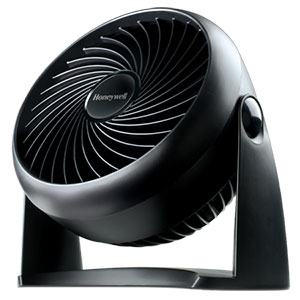
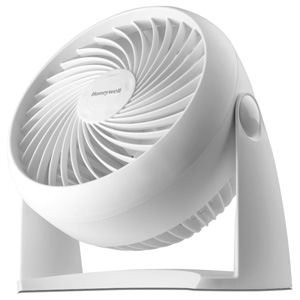
Honeywell TurboForce Air Circulator Positioning
Effective Honeywell TurboForce air circulator positioning depends on whether you want direct
cooling, HVAC-air distribution or whole-room mixing.
For Personal Cooling
Place the fan on a dry, level surface.
Point the adjustable head toward the occupied area.
Use the lowest speed that maintains comfort.
Keep papers, curtains and loose fabrics away from the intake.
For Whole-Room Mixing
Aim the fan slightly upward toward the opposite wall.
Try a wall-and-ceiling corner to spread airflow across the room.
Place the fan near the room’s perimeter rather than in a cluttered corner.
Keep the back grille several inches away from obstructions.
For Moving Air Between Rooms
Open the connecting doorway.
Place the air circulator near the floor on the cooler side of the doorway.
Aim it into the warmer room.
Leave the upper portion of the doorway unobstructed so warmer air can return.
Moving dense, cooler air along the floor into the warmer space often establishes a two-way circulation pattern
through the doorway.
Using a Fan With Air Conditioning
Knowing how to use fan with air conditioner to save energy can help you stay comfortable at a
warmer thermostat setting.
Raise the Thermostat Gradually
The U.S. Department of Energy has stated that air movement from a ceiling fan can allow occupants to raise an
air-conditioning thermostat by about 4°F without reducing comfort. That specific figure is based on ceiling-fan
guidance.
A well-positioned portable fan can provide a similar personal cooling effect, but room coverage varies. A practical
approach is:
Set the air conditioner to your usual comfortable temperature.
Turn on the portable fan in the occupied area.
Raise the thermostat by 1°F.
Wait long enough to evaluate comfort.
Increase it another degree if the room still feels comfortable.
Continue gradually, up to approximately 4°F when conditions permit.
People who are older, medically vulnerable or sensitive to heat should prioritize safe indoor temperatures over
energy savings.
Keep Windows Closed While the AC Runs
Cross-ventilation and air conditioning are normally separate strategies. When the air conditioner is operating:
Close exterior windows and doors.
Close shades on sunny windows.
Use portable fans to circulate already-conditioned indoor air.
Do not exhaust cooled air through a window.
Move Cool Air Away From Supply Vents
Do not place a fan directly against an HVAC register. Instead, position it several feet away so it captures and
carries cool air farther into the room without blocking the vent.
Identify the room’s cooling-supply vent.
Place the fan beyond the vent’s immediate discharge area.
Aim it toward the occupied zone or opposite side of the room.
Keep return-air grilles unobstructed.
Push Cool Air Into an Adjacent Room
If one room is cooler than another:
Open the connecting door.
Place a floor fan low in the cooler room.
Aim it through the doorway into the warmer room.
Use low or medium speed.
Allow warmer air to return through the upper portion of the doorway.
This works better than placing the fan high and attempting to push warm air out of the hotter room.
Fan Placement for Common Room Problems
Hot Bedroom
Use direct airflow across the bed for immediate comfort.
Use a low-noise setting for sleeping.
When outdoor air is cooler, exhaust warm air through one window and admit cool air through another.
Use the timer so the fan does not run longer than needed.
Warm Upstairs Room
Exhaust hot air through an upper-story window after outdoor temperatures fall.
Open a shaded lower-level window for replacement air.
Keep doors along the airflow path open.
Use caution with window security and naturally drafting combustion appliances.
Room With One Window
Place the fan several feet inside the room and aim it outward.
Open the room door to provide replacement air.
Open a cooler window elsewhere in the home when available.
If no cooler air source exists, use the fan for direct personal cooling instead.
Long Hallway
Place a strong air circulator near one end.
Aim it down the hallway at a slight upward angle.
Open the destination-room doors.
Keep the fan and cord out of the walking path.
Nighttime Cooling Strategies
Night ventilation works best in climates where outdoor temperatures fall substantially after sunset.
Evening Heat-Flush Routine
Keep windows and shades closed during the hottest part of the day.
Check outdoor temperature and air quality after sunset.
Open a shaded intake window.
Open an exhaust window on the warmer or upper side of the home.
Run the exhaust fan at medium or high speed.
Open interior doors along the airflow path.
Reduce fan speed after the indoor temperature falls.
Close windows in the morning before outdoor air becomes warmer.
Use the Timer for Sleep
A one-, two-, four- or eight-hour timer can prevent the fan from running all night when only early-evening cooling
is needed.
Use direct low-speed airflow when falling asleep.
Choose oscillation if a constant breeze feels uncomfortable.
Dim or turn off the control-panel light on compatible models.
Keep the fan on a stable surface where bedding cannot block the grille.
Fan Air Circulation Tips
Use the lowest speed that provides adequate comfort.
Keep intake and outlet grilles clean.
Do not block the fan’s rear intake with furniture or curtains.
Aim air along an open path rather than into nearby clutter.
Use oscillation for broad coverage and steady airflow for one occupied location.
Turn off direct-comfort fans in empty rooms.
Use outdoor-air ventilation only when outside conditions are favorable.
Close blinds and shades before sunny rooms overheat.
Limit heat-producing appliances during the hottest part of the day.
Clean accumulated dust because restricted grilles reduce airflow.
Efficient Fan Strategy at a Glance
Hotter outside than inside: Close windows and use direct airflow or air conditioning.
Cooler outside than inside: Open opposing windows and create cross-ventilation.
Air conditioner running: Close windows and circulate conditioned air.
One occupied area: Aim the fan directly at the people in that area.
Several occupied areas: Use oscillation or a whole-room circulation pattern.
Empty room: Turn the fan off unless it is actively ventilating or transferring air.
Efficient Fan Cooling Questions
Should a Fan Face Into or Out of a Window?
Face it inward when outdoor air is cooler and you want an intake fan. Face it outward when removing warmer indoor
air. The most effective setup commonly uses a shaded intake on one side and an exhaust fan on the other.
Does Putting Ice in Front of a Fan Cool the Room?
Ice can temporarily cool the air immediately around the container, but the effect is limited and adds humidity as
the ice melts. Keep water and condensation safely away from the fan, cord and electrical outlet.
Should I Place a Fan on the Floor or a Table?
Use floor placement to move dense cool air between rooms or along a hallway. Elevate the fan when direct airflow
needs to reach a seated person or bed. Always use a stable, dry and level surface.
Should I Run a Fan With the Air Conditioner?
Yes. Air movement can improve comfort and may allow a warmer thermostat setting. Keep windows closed and direct the
fan toward occupied areas or locations that receive insufficient conditioned air.
Does a Fan Actually Lower Room Temperature?
A fan alone generally does not lower the air temperature in a closed room. It can lower room temperature when it
exchanges warm indoor air for cooler outdoor air.
How Far Should an Exhaust Fan Be From a Window?
There is no universal distance. For a portable air circulator, begin approximately two to three feet back and adjust
the distance to produce the strongest airflow through the room. Use a window-approved fan if placing it directly in
the opening.
Contact options may differ depending on the type of help you need.
Cookie Preferences
This site uses a small number of cookies to provide a secure and reliable shopping experience.
Required cookies are set directly by this site and are used only for essential store functions such as maintaining your shopping cart, processing checkout, providing security, and keeping the site working properly. We also use optional Google cookies for website analytics and advertising measurement. You can choose whether to allow these Google cookies below.
Required Cookies
These cookies are necessary for essential website functions, including your shopping cart, checkout, site security, and maintaining your shopping session. These cookies are set directly by this site and cannot be disabled.
Always Active
Google Analytics & Advertising Cookies
We use Google services to understand how customers use this site, improve site performance and navigation, and measure the effectiveness of our advertising. These cookies are optional. Turning them off will not affect your ability to browse, shop, or complete an order.
Learn more about how we protect your information in our Privacy Policy.